Work Collection

Work Collection

pyRTC AI Copilot

pyRTC AI Copilot

Designing an AI-assisted workspace for astronomy researchers

Designing an AI-assisted workspace for astronomy researchers

A UX capstone project with SHARP Imaging Labs that reimagines pyRTC from a command-line adaptive optics tool into an intelligent research workspace that helps users monitor, troubleshoot, and understand real-time telemetry.

A UX capstone project with SHARP Imaging Labs that reimagines pyRTC from a command-line adaptive optics tool into an intelligent research workspace that helps users monitor, troubleshoot, and understand real-time telemetry.

View Interactive Prototype ↗

View partner's website ↗

AfterBefore
Before
After

Project summary

Role

Timeline

Team

UX Researcher

Product Designer

Jan–Apr 2026

4 UX Designers

Partner

Focus

SHARP Imaging Labs

Dunlap Institute

AI UX, Scientific Software, Dashboard Design, Telemetry Analysis

Project context

PyRTC in Astronomy Research Field

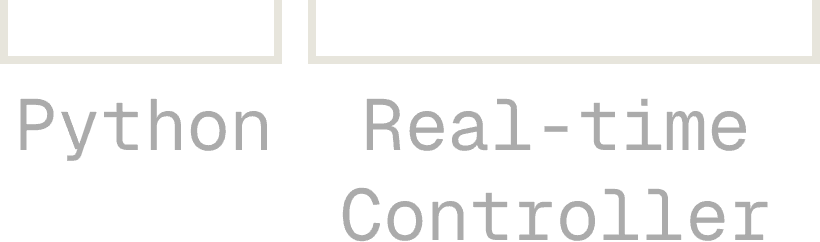
py = PYTHON

RTC = Real time controler

pyRTC = Web-based, open source software for adaptive optics (AO)

Why pyRTC matters?

Adaptive optics workflows are highly time-sensitive and knowledge-heavy. Researchers need to interpret live telemetry, tune parameters, and troubleshoot system issues while experiments are running. The current interface relies primarily on the command line and a simple viewer.

The privious work space

01 / The Challenge

Fragmented tools,
Fragmented data,
Fragmented expertise

Fragmented tools,
Fragmented data,
Fragmented expertise

Fragmented tools,
Fragmented data,
Fragmented expertise

Researchers could see data, but not easily understand or act on it.

Fragmented tools

Terminal commands, separate viewer windows, manual configuration.

Terminal commands, separate viewer windows, manual configuration.

Terminal commands, separate viewer windows, manual configuration

Fragmented data

Live streams were visible, but difficult to inspect, record, replay, or compare.

Live streams were visible, but difficult to inspect, record, replay, or compare.

Live streams were visible, but difficult to inspect, record, replay, or compare.

Fragmented expertise

New users depended on undocumented knowledge, mentorship, and trial-and-error.

New users depended on undocumented knowledge, mentorship, and trial-and-error.

New users depended on undocumented knowledge, mentorship, and trial-and-error.

02 / Research question

How might we help AO researchers understand, diagnose, and act on real-time system behavior without relying entirely on expert intuition?
How can AI support scientific decision-making while preserving researcher control and trust?

03 / Research process

Researching how researchers operate and troubleshoot pyRTC

Researching how researchers operate and troubleshoot pyRTC

Researching how researchers operate and troubleshoot pyRTC

How did we reveal the problem and pain points?

Approach

We studied how researchers monitor live systems,
identify problems,
recover from errors.

We studied how researchers monitor live systems,
identify problems,
recover from errors.

Approach

001
LAB VISIT
We watch the demo of pyRTC by client and all day-to-day tools
002
INTERVIEW
We conducted 4 interviews with pyRTC users to understand their current workflow and pain points
003
COMPETITIVE ANALYSIS
We found the current tools being either very expensive and powerful, but visually lacking and cluttered
· Alpao
· CACAO / DARC

Alpao Dashboard

004
AFFINITY MAPPING
We identified recurring terms and themes, then clustered to a affinity map
005
Persona
We created two personas to illustarte the main users

04 / key Research insights

Researching how researchers operate and troubleshoot pyRTC

Researching how researchers operate and troubleshoot pyRTC

Why is pyRTC AI copilot admissible?

How did we reveal the problem and pain points?

What are the main research findings that lead us to the conncept?

01

Users were not just operating software;

they were constantly diagnosing a system

The system should surface relationships between telemetry streams, not just display them separately.

The system should surface relationships between telemetry streams, not just display them separately.

AI Feature

AI Feature

「AI Diagnostic Assistant」

「AI Diagnostic Assistant」

Users were not just operating software;

they were constantly diagnosing a system

02

Debugging relied on pattern recognition and tacit knowledge

Debugging relied on pattern recognition and tacit knowledge

AI should help detect patterns, correlate signals, and explain likely causes.

AI should help detect patterns, correlate signals, and explain likely causes.

AI Feature

AI Feature

「Anomaly detection
+
Cause suggestion」

「Anomaly detection
+
Cause suggestion」

03

New users needed contextual guidance, not generic documentation

Guidance should appear in context, connected to the live component or error the user is seeing.

Guidance should appear in context, connected to the live component or error the user is seeing.

AI Feature

AI Feature

「Contextual API Assistant」

「Contextual API Assistant」

New users needed contextual guidance, not generic documentation

04

Experts wanted control, not automation

AI should recommend, explain, and provide confidence — but the user decides.

AI should recommend, explain, and provide confidence — but the user decides.

AI Feature

AI Feature

「Recommendation cards with evidence」

Experts wanted control, not automation

05 / DESIGN DIRECTION

Design direction:
an AI Copilot for adaptive optics workflows

Design direction:
an AI Copilot for adaptive optics workflows

How did we reveal the problem and pain points?

What are the main research findings that lead us to the conncept?

Based on research, we reframed pyRTC from a command-line-controlled monitoring tool into an AI-assisted workspace.

The goal was not to replace researchers, but to help them interpret system behavior, troubleshoot faster, and learn from live telemetry.

06 / FINAL CONCEPT

The solution:
pyRTC AI Copilot

The solution:
pyRTC AI Copilot

What are the core features?

  1. Live Diagnostic Copilot

Analyzes real-time telemetry and flags abnormal system behavior.

  1. Live Diagnostic Copilot

Analyzes real-time telemetry and flags abnormal system behavior.

  1. Evidence-based Recommendation Cards

pyRTC copilot provides suggestions, but does not enforcement.

  1. Evidence-based Recommendation Cards

pyRTC copilot provides suggestions, but does not enforcement.

  1. Contextual API Assistant

When a user hover on a particular component, the AI provides an explanation of the relevant API.
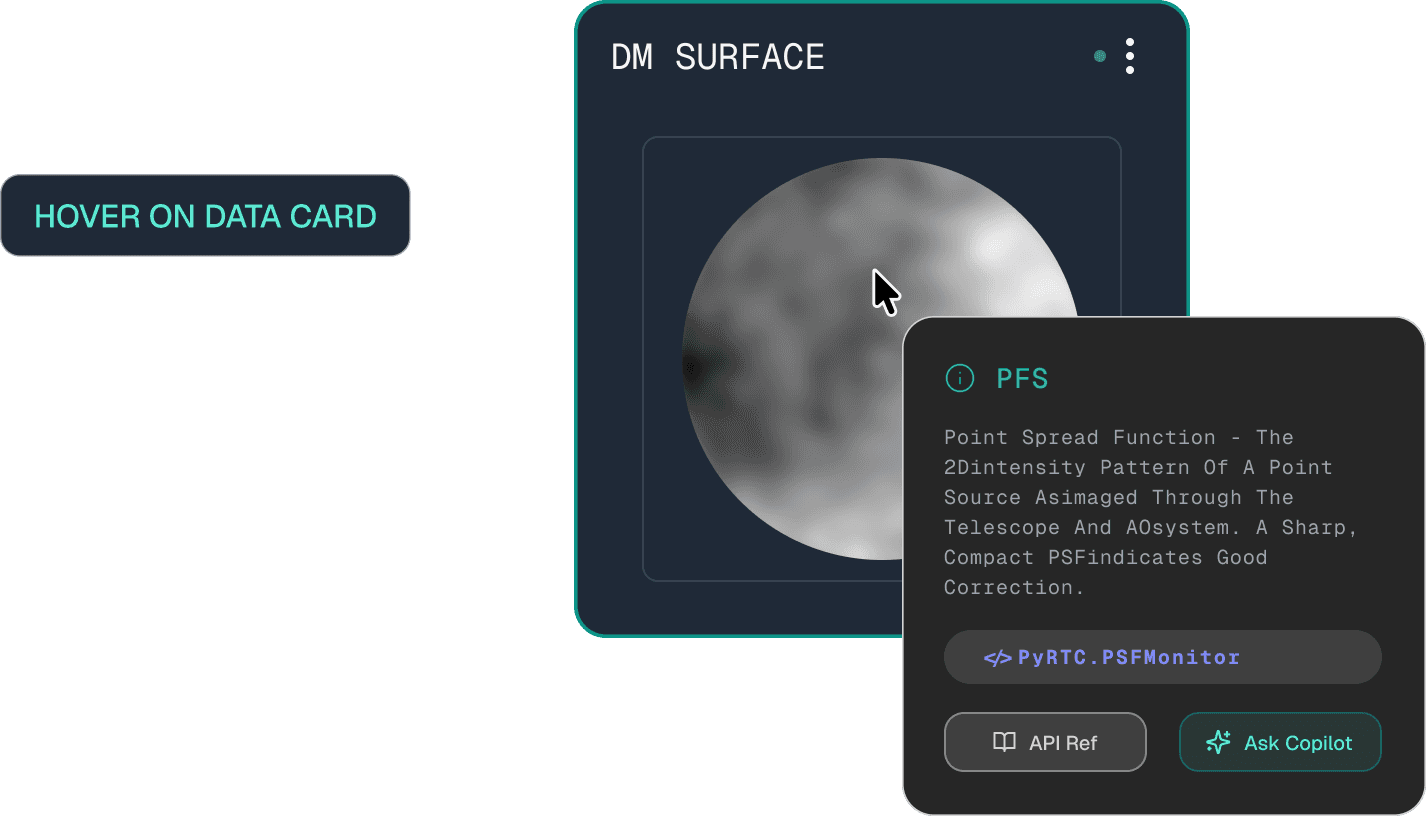
Users can check the enbemded API Reference or ask AI Copolit to learn more.

  1. AI Replay Summary

At the end of the experiment, AI Copilot summarises the key data and generates a report.

07 / Impact and Reflection

How our design impact users:
from monitoring data to understanding system behavior

How our design impact users:
from monitoring data to understanding system behavior

Our AI AO research copilot affect the 3 major user groups in multiple ways.

What are the main research findings that lead us to the conncept?

USER GROUP 01

For junior researchers

Faster understanding of unfamiliar AO workflows

Less dependency on expert supervision

Contextual learning through live system behavior

USER GROUP 02

For expert researchers

Faster debugging

Better experiment review

Less manual interpretation across fragmented windows

PRODUCT IMPACT

For pyRTC as a product

Repositioned pyRTC from a lightweight controller into an intelligent research workspace

Created a scalable AI interaction model for telemetry, documentation, and replay

Hear from our Client -—>